
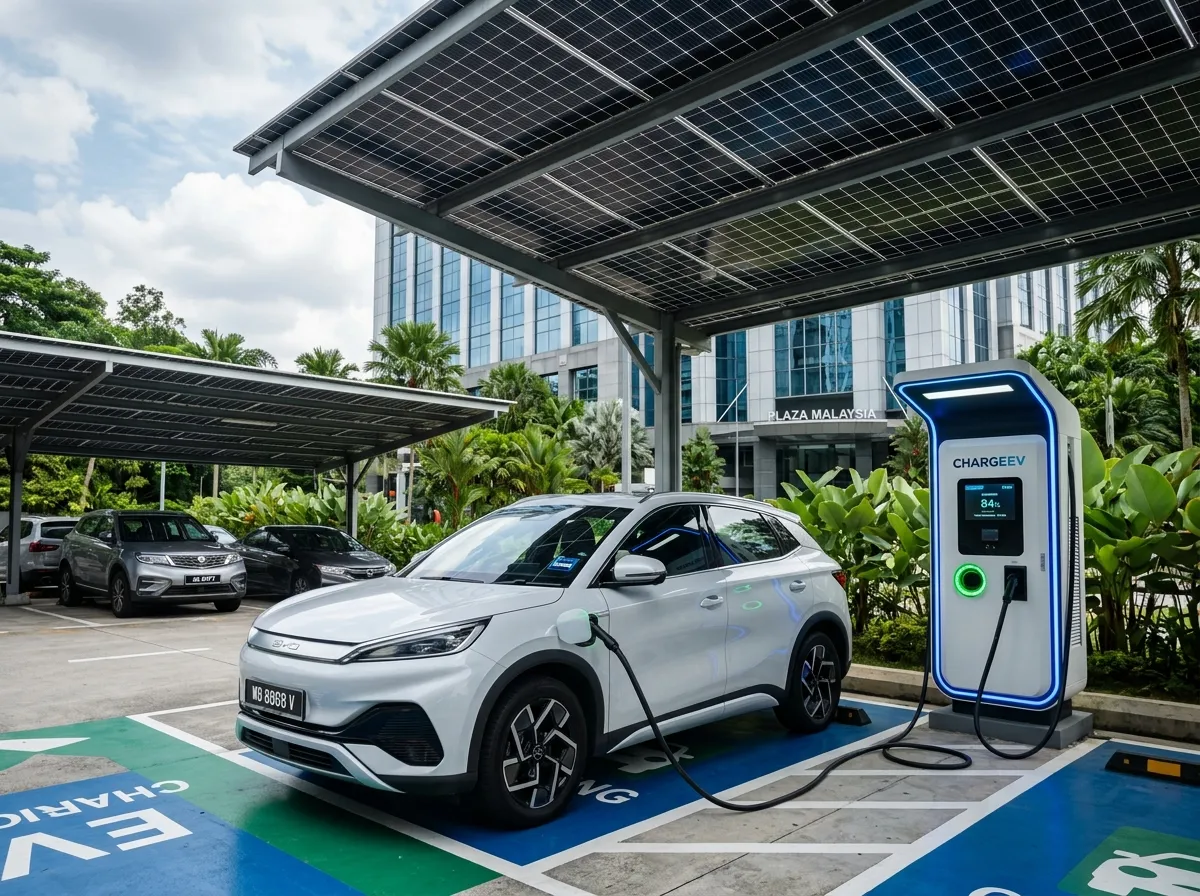
Solar-powered EV charging reduces your charging cost to near-zero during the day and positions your property as future-ready. Malaysia is pushing EV adoption hard—having a charger adds property value. Pairing a solar system with an EV charger means daytime charging is powered directly from your panels, eliminating grid electricity costs for that usage. Easy Solar has installed both residential (22 kW AC at Society Kidney Sabah) and commercial (120 kW DC at Lexus KK) systems that charge vehicles during peak sun hours.
Why Pair Solar with EV Charging?
Daytime solar generation perfectly aligns with typical EV charging windows. Here is why this pairing works:
- Daytime match: Solar output peaks 9 AM–3 PM; most vehicles charge during business hours or when owners are at work.
- Zero grid electricity for charging: A 6.6 kWp home solar system can charge a typical EV (60 kWh battery) in 4–6 hours at full sun.
- Business cost savings: Commercial properties with high daytime loads benefit most. A DC fast charger (50–120 kW) consumes massive grid power; solar offsets this entirely during peak production.
- Future-proofs your property: EV ownership is rising in Malaysia. A dedicated charger increases resale value and attracts EV-driving tenants.
- Reduces peak demand charges: Businesses pay premium rates for peak-hour electricity. Solar-powered charging flattens your demand curve, lowering bills.
Even on cloudy days, grid-tied solar systems automatically provide backup, so your charger never stops working.
Types of EV Chargers: AC vs DC
EV chargers come in two main types, each with different solar pairing considerations:
| Charger Type | Power Output | Use Case | Solar Pairing |
|---|---|---|---|
| Level 2 AC | 7–22 kW | Homes, offices, fleet depots | A 5–10 kWp system supports seamless charging |
| DC Fast Charge | 50–120+ kW | Commercial, highways, public networks | Requires 30+ kWp system or battery storage |
Easy Solar installed examples:
- Lexus Kota Kinabalu: 120 kW DC fast charger paired with ground-mounted solar. Charges vehicles in 20–30 minutes, powered by solar during peak hours.
- Society Kidney Sabah: 22 kW Level 2 AC charger for staff vehicles. Paired with a 15 kWp rooftop system, fully covers charging during business hours.
How Much Solar Do You Need for EV Charging?
System sizing depends on charger type, daily charging demand, and your climate. Use this table as a guide:
| Charger Type | Recommended Solar Size | Daily Charging Capacity (at full sun) | Typical Cost (installed) |
|---|---|---|---|
| 7 kW Level 2 (home) | 5–8 kWp | Charge 1 EV fully in 4–6 hours | RM30,000–45,000 |
| 11 kW Level 2 (office) | 8–12 kWp | Charge 2 vehicles partially or 1 fully | RM45,000–65,000 |
| 22 kW Level 2 (fleet) | 15–20 kWp | Charge 3–4 vehicles during day | RM70,000–100,000 |
| 50 kW DC Fast (commercial) | 30–40 kWp | 30-min charges, 4–6 vehicles/day | RM150,000–220,000 |
| 120 kW DC Fast (highway) | 50–70 kWp + battery | 20-min charges, 8–10 vehicles/day | RM250,000+ |
Pro tip: Sabah receives 3.5–4.5 kWh per 1 kWp daily (vs. 5+ kWh in Peninsular). Size your system 15–20% larger to account for tropical cloud cover and rain.
Malaysia EV Incentives: Tax Breaks & Grants
The Malaysian government actively incentivizes EV adoption and solar energy. Take advantage of these programs:
- EV purchase tax relief: Import duty exemption and sales tax reduction on fully electric vehicles (saving RM20,000–50,000 per car).
- EV charger tax deduction: Corporations can deduct EV charger installation costs from taxable income. Residential deduction under review.
- Green Technology Financing Scheme (GTFS): Soft loans for solar systems at 2% interest (vs. market 6–8%). Chargers paired with solar may qualify.
- ASNB Green Fund: If you have ASNB units, invest in sustainable assets (solar + EV charger) for tax-deferred returns.
- SELCO (Self-Consumption) expansion: Sabah now permits systems up to 100% of load (was 85%) with zero-export. DC fast chargers qualify if grid-compliant.
Consult Easy Solar's team or your tax advisor to structure the investment for maximum incentive capture.
Calculate Your EV Charging Solar Savings
Our engineers will size a system for your charger and estimate payback in 3–6 years.
Chat on WhatsAppReal-World Example: Office Fleet Charging
A 10-person office in Kota Kinabalu wants to install a 22 kW Level 2 charger for employee vehicles. Here is the math:
- Daily charging demand: 5 vehicles × 40 kWh per vehicle = 200 kWh/day (spread 8 AM–4 PM)
- Solar system needed: 15 kWp (accounts for Sabah weather and inverter losses)
- Annual solar generation: 15 kWp × 4 kWh/day × 365 days = 21,900 kWh
- Grid electricity saved: 200 kWh × 250 working days = 50,000 kWh/year → Cost savings RM12,500–15,000/year
- System cost: RM70,000–85,000 (solar + charger + installation)
- Payback period: 5–6 years (improves with tariff increases)
- 25-year savings: RM312,500–375,000
Frequently Asked Questions
Can I charge an EV on a rainy day with solar?
Yes. Grid-tied systems automatically draw from SESB when solar output drops (cloudy, rainy, night). Your charger never stops—it simply switches to grid power seamlessly. This is why battery storage is optional for systems under 1 MWac.
Do I need a battery for EV charging with solar?
Not for most setups. Batteries are only required for systems over 1 MWac under SELCO rules. For homes and offices, grid-tied charging (solar by day, grid by night) is cost-effective and reliable. If you want backup power or 24/7 solar charging, battery storage adds RM40,000–80,000 and extends payback by 2–3 years.
What is the difference between AC and DC charging for solar?
AC (Level 2) chargers are smaller (7–22 kW), work with standard home/office panels, and charge overnight or over several hours. DC fast chargers (50–120 kW) need large solar systems or batteries and offer rapid charging (20–30 min). For homes, AC is standard. For commercial networks, DC is essential.
Will an EV charger work with SELCO (zero-export)?
Yes. EV chargers are treated as any other load under SELCO. Solar generation that would otherwise be wasted (excess, no export allowed) can be redirected to the charger. This is ideal—it increases self-consumption and improves your ROI without violating zero-export rules.
How much does an EV charger cost to install?
Level 2 chargers (7–22 kW): RM8,000–15,000 installed. DC fast chargers (50–120 kW): RM30,000–60,000+ depending on power and grid upgrades needed. Easy Solar handles site assessment, electrical upgrades, and final commissioning.