SELCO (Self-Consumption solar, or SELCO-PV SABAH) is a solar programme in Sabah where your system generates electricity only for your own use — nothing is exported back to the grid. It is the route for commercial and industrial premises, and those systems must be zero-export, because the state's grid has limited capacity. SELCO is regulated by the Energy Commission of Sabah (ECoS). Since 2026, Sabah homeowners have a separate route that does allow export for bill credits — Solar Rakyat Sabah, the state's residential net energy metering scheme.
How Does a SELCO System Work?
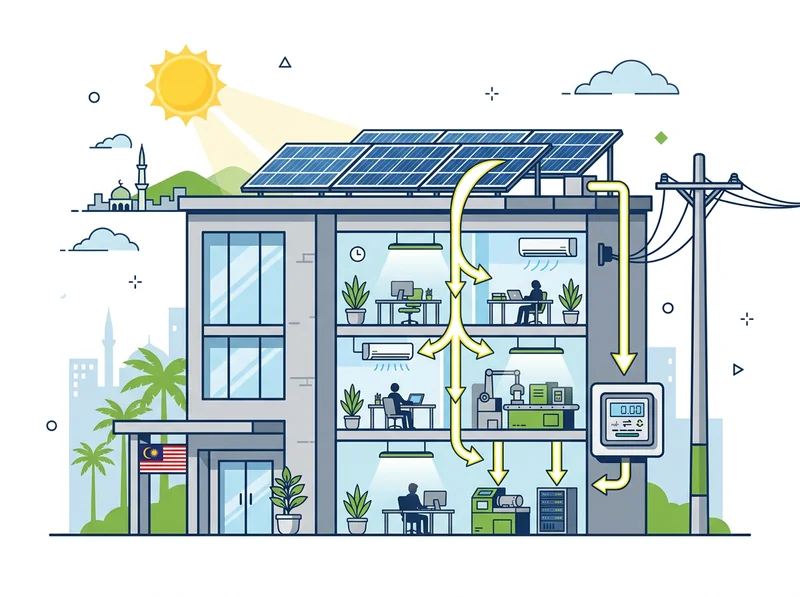
A SELCO system connects solar panels directly to your building's internal electrical distribution board. Here's the flow:
- Solar panels generate DC electricity during the day.
- Inverter converts DC to AC electricity (the standard for appliances).
- Connection point: The inverter feeds power directly into your internal distribution board, not the public grid.
- Your consumption: All generated power is used by your own equipment—lights, AC, machinery, etc.
- Grid connection: When you need more power than the panels generate (cloudy days, night), the grid supplies the difference.
- No export: Any excess generation is either wasted or stored (if you have a battery), never sent back to Sabah Electricity Sdn Bhd (SESB).
The system is monitored and must comply with ECoS regulations at all times.
Why Can't a SELCO System Sell Excess Power in Sabah?
Sabah's electrical grid operates with a very tight reserve margin—only about 12% spare capacity compared to Peninsular Malaysia's 30%. This means SESB cannot accept power flowing back from customers because the grid would become unstable.
Zero export is a condition of a SELCO installation, and it exists for good engineering reasons:
- Protects grid stability and prevents voltage spikes
- Reduces strain on aging distribution infrastructure
- Eliminates synchronization issues
- Prevents safety hazards for maintenance crews
Update, July 2026: net energy metering is now available in Sabah. When this article was first published, SELCO was the only route for distributed solar in Sabah. That has changed. Sabah homeowners can now export surplus solar to Sabah Electricity for bill credits under Solar Rakyat Sabah, the state's residential net energy metering scheme. The zero-export rules described below still apply to commercial and industrial self-consumption systems, which is what SELCO is for. For a full explanation of the residential scheme, read how Solar Rakyat Sabah works.
For commercial and industrial systems, SELCO remains the route in Sabah, and export is not permitted. Residential net energy metering now sits alongside it as a separate programme with its own rules and capacity limits.
| Feature | SELCO (commercial, Sabah) | NEM / Solar Rakyat (residential, Sabah) |
|---|---|---|
| Who it is for | Commercial and industrial premises | Domestic SESB account holders |
| Export allowed | No (zero-export only) | Yes — surplus is exported to Sabah Electricity |
| Compensation for excess | None — savings come from self-consumption | Bill credits at the gazetted domestic tariff (no cash payout) |
| System size limit | Sized to your own daytime load | 5 kWac single-phase / 10 kWac three-phase |
| Battery requirement | Only for systems >1 MWac | Not required (permitted, for self-consumption only) |
| Metering | Existing meter with an export-limiting device | Smart meter from SESB (RM400 single / RM450 three-phase) |
Who Can Install SELCO in Sabah?
SELCO is available to most electricity consumers in Sabah, with one key restriction:
You are eligible if: You have never installed a solar system under the previous Feed-in Tariff (FiT) programme. Once a customer uses FiT, they cannot switch to SELCO.
Eligible customer types include:
- Commercial & Industrial (C&I): No more 85% capacity cap—you can now install up to 100% of your maximum load
- Residential: Homeowners and apartment buildings
- Industrial premises: Factories, warehouses, manufacturing
- Educational institutions: Schools, universities, training centres
- Non-profit organizations: NGOs, social enterprises
As of January 2025, regulations now allow ground-mounted and floating solar systems (previously rooftop-only), giving businesses more installation flexibility.
What Size System Do I Need?
Your system size should match your daytime electricity consumption. Here's how to determine it:
- Review your SESB bill. Find your average daytime consumption (usually peak between 9 AM–5 PM).
- Account for seasonal variation. Sabah's cloudy weather means average daily generation is 3.5–4.5 kWh per 1 kWp installed (vs. 5+ kWh in Peninsular).
- Calculate system size: If you use 100 kWh/day during the day, a 20–25 kWp system will typically meet that (accounting for weather, shading, and inverter losses).
- Battery consideration: For systems over 1 MWac, you must install a battery storage system (BESS) to store excess generation.
- Avoid oversizing. Oversized systems waste generated power and increase costs without benefit.
Pro tip: An ECoS-certified installer (like Easy Solar) can run a site assessment and energy audit to right-size your system within 15 minutes.
How Much Can SELCO Save My Business?
For a typical commercial property in Kota Kinabalu:
- System size: 25 kWp roof-mounted
- Annual generation: ~100 MWh (accounting for Sabah's weather)
- Annual bill reduction: RM25,000–30,000 (at RM0.25–0.30/kWh SESB tariff)
- System cost: RM110,000–140,000 (installed, all-in)
- Payback period: 4.5–5.5 years
- 25-year lifetime savings: RM625,000–750,000
Industrial users with higher daytime loads see payback in 3–4 years. Payback improves if your tariff increases (typically 5% annually in Sabah).
Get a Free Solar Assessment
Let our ECoS-certified engineers calculate your exact savings and system size.
Chat on WhatsAppHow Do I Apply for SELCO in Sabah?
Step-by-step application process:
- Step 1: Site Assessment (Week 1)
Easy Solar conducts a free on-site inspection to check roof structure, shading, electrical capacity, and energy usage.
- Step 2: System Design & Quote (Week 1–2)
We design a zero-export compliant system, provide equipment specs, and present a fixed quote. Approval from you is required before proceeding.
- Step 3: ECoS Application (Week 2–3)
Easy Solar submits your SELCO application to the Energy Commission of Sabah with technical drawings, single-line diagrams, and compliance documentation. No back-and-forth paperwork required from you.
- Step 4: ECoS Technical Review & Approval (Week 3–6)
ECoS reviews the application for grid safety and zero-export compliance. Usually approved in 2–3 weeks (can take up to 6 weeks in peak season).
- Step 5: Installation (Week 7–9)
Once approval is received, Easy Solar installs panels, inverter, monitoring system, and zero-export relay. Installation typically takes 2–5 days depending on system size.
- Step 6: Inspection & Final Approval (Week 9–10)
ECoS conducts a final site inspection. Once passed, you receive the Certificate of Completion and grid connection is finalized.
- Step 7: Go Live & Monitoring (Week 10+)
System starts generating and saving you money immediately. Easy Solar provides 3 years of free monitoring and O&M support.
Total timeline: 8–12 weeks from initial consultation to system generation, depending on ECoS processing speed.
Recent SELCO Regulation Changes (2025)
The Energy Commission of Sabah updated SELCO rules effective January 2025:
- Capacity cap removed: C&I users no longer limited to 85% of maximum load; can now install up to 100%.
- Mounting flexibility: Ground-mounted and floating solar now allowed (previously rooftop-only).
- Battery requirement raised: BESS now required only for systems >1 MWac (was 72 kWp). Smaller systems don't need batteries.
- Faster processing: ECoS target approval time is now 14 days for standard applications.
- Export monitoring: All systems must have real-time monitoring to ensure zero export compliance.
These changes make SELCO more accessible and cost-effective for small and medium businesses.
Frequently Asked Questions
Can I use SELCO if I'm still on FiT?
No. Once you've installed a system under the FiT (Feed-in Tariff) programme, you cannot switch to SELCO. FiT and SELCO are mutually exclusive. If you're still receiving FiT revenue, that contract continues until expiry (typically 21 years from commissioning). New solar installations must use SELCO.
What happens on a cloudy or rainy day?
On cloudy days, your solar system generates less power—typically 10–30% of rated capacity. You automatically draw the shortfall from SESB as usual. There's no penalty or extra charge. The grid seamlessly covers any gap. This is normal and expected in Sabah's tropical climate.
Do I need a battery backup for SELCO?
Batteries are not required for most systems. Only installations larger than 1 MWac must have battery storage (BESS). For smaller residential and commercial systems, you rely on the SESB grid at night and on cloudy days. This is cost-effective and reliable.
How long does an ECoS approval take?
Target approval time is 14 days for standard applications as of 2025. In practice, it typically takes 2–3 weeks for straightforward systems. Peak season (March–June) can extend this to 4–6 weeks. Easy Solar handles all communication with ECoS—you don't need to chase approvals.
Can I expand my SELCO system later?
Yes, but you'll need a new ECoS application for any significant expansion (usually >20% increase). We recommend designing your system with future growth in mind during the initial assessment to avoid multiple approvals. Contact us to discuss expansion strategies.