
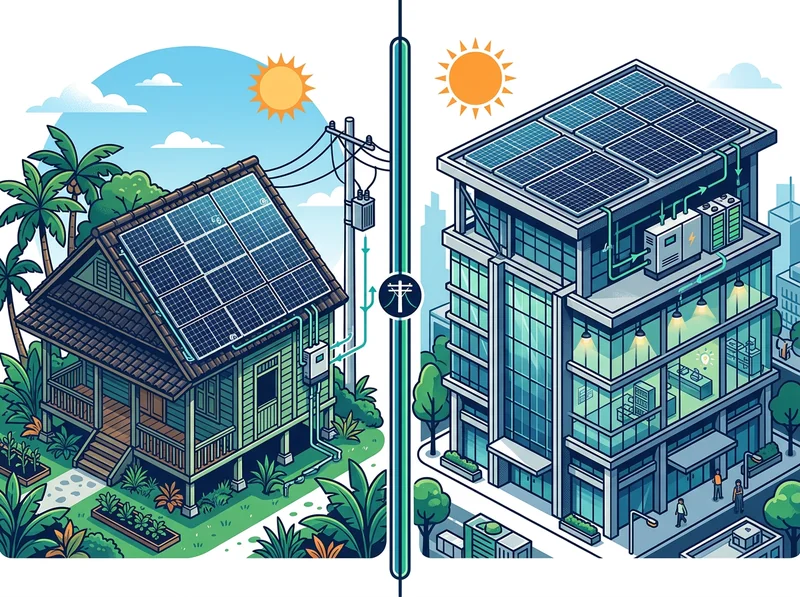
Solar ATAP is Malaysia's new national net energy metering programme for residential and small commercial users in Peninsular Malaysia, launching in 2026. It replaces the FiT and NEM 3.0 schemes and allows you to export excess solar power to the grid. SELCO is Sabah's self-consumption programme for commercial and industrial premises, where all generated power must be used on-site — zero export. Since 2026, Sabah homeowners have their own net energy metering route as well: Solar Rakyat Sabah, which does allow export to Sabah Electricity for bill credits. So the honest answer for a Sabah reader is that it depends on your premises — Solar Rakyat for a home, SELCO for a business.
What Is Solar ATAP?
Solar ATAP (Skim Solar ATAP, meaning "Solar Rooftop Scheme") is Malaysia's newest solar incentive programme launched in early 2026 by the Ministry of Energy and Natural Resources (KeTSA). It is the replacement for both the Feed-in Tariff (FiT) and NEM 3.0 schemes.
Key features of ATAP:
- Available to residential and small commercial installations across Peninsular Malaysia
- Allows export of excess solar power to the national grid
- Compensation for exported power ranges from RM0.35–0.50/kWh depending on grid conditions
- No capacity restrictions—size your system to your needs
- Covers Selangor, Kuala Lumpur, Johor, Penang, Perak, Pahang, and all other Peninsular states
- Simple online registration through a dedicated ATAP portal
- Operates on a 20-year contract with automatic renewal option
ATAP is designed to accelerate solar adoption by allowing homeowners and businesses to recoup their investment faster through grid export revenue, while supporting Peninsular Malaysia's renewable energy targets.
What Is SELCO?
SELCO (Self-Consumption Solar, or SELCO-PV SABAH) is Sabah's own solar regulation. Unlike ATAP, SELCO requires zero export—all power generated by your system must be used on-site. It is the only solar programme available to residential and commercial customers in Sabah.
Key features of SELCO:
- Applies to all residential and commercial installations in Sabah
- Strictly zero-export: excess power cannot be sold to the grid
- Regulated by the Energy Commission of Sabah (ECoS)
- Payback achieved through bill reduction only (no export revenue)
- Systems are sized to match daytime consumption (avoid oversizing)
- Real-time monitoring required to ensure zero-export compliance
- Battery storage required for systems larger than 1 MWac
SELCO exists because Sabah's electrical grid (operated by Sabah Electricity Sdn Bhd, SESB) has limited capacity and cannot safely accept power flowing back from customers. This protects grid stability.
ATAP vs SELCO: Head-to-Head Comparison
| Feature | Solar ATAP (Peninsular Malaysia) | SELCO (Sabah Only) |
|---|---|---|
| Export to grid | Yes—100% of capacity | No—zero export only |
| Compensation for excess | RM0.35–0.50/kWh (contract rate) | None—no export possible |
| Geographic availability | Peninsular Malaysia only (Selangor, KL, Johor, Penang, Perak, Pahang, etc.) | Sabah only |
| Regulatory body | Ministry of Energy (KeTSA) | Energy Commission of Sabah (ECoS) |
| Contract period | 20 years with auto-renewal | Renewable annually or long-term (depends on ECoS) |
| System sizing freedom | Size to your needs—no restrictions | Size to daytime consumption only (avoid oversizing) |
| Battery requirement | Not required | Required only for systems >1 MWac |
| Typical payback period | 4–6 years (including export revenue) | 6–8 years (bill reduction only) |
| Monitoring requirement | Standard grid monitoring | Real-time zero-export monitoring (mandatory) |
| Annual grid tariff increases | Both ATAP rates and import rates increase ~5% per year | SESB tariff increases ~5% per year (improves payback) |
| Eligible customers | Residential, commercial, small businesses | Residential, commercial, industrial, educational, non-profit |
Which Programme Is Right for You?
Your location decides the programme family, and your premises decides which one within it.
If you are a homeowner in Sabah: Solar Rakyat Sabah is your route — Sabah's residential net energy metering scheme, open since 2026. You export surplus to Sabah Electricity and receive bill credits at the gazetted domestic tariff, up to 5 kWac single-phase or 10 kWac three-phase. Peninsular programmes like ATAP do not apply in Sabah.
If you run a business in Sabah: SELCO is your route. Export is not permitted, so design the system to match your daytime consumption and take the saving from self-consumption over a 25-year panel life.
If you are in Peninsular Malaysia (Selangor, KL, Johor, Penang, Perak, Pahang, etc.): ATAP is your pathway to solar. You can size your system larger than your consumption, export excess power to the grid, and earn RM0.35–0.50/kWh on that export. Payback is typically 4–6 years, faster than SELCO due to export revenue.
Important note: If you are currently in Peninsular Malaysia but considering moving to Sabah, or vice versa, consult with an installer before committing. Your ATAP contract will not be valid in Sabah, and you would need to decommission and re-design under SELCO rules (if eligible).
Why Are ATAP and SELCO So Different?
The two programmes exist because of differences in grid infrastructure:
- Peninsular Malaysia's grid: Operates with ~30% reserve capacity. This surplus allows the grid to safely accept solar exports from thousands of customers without destabilizing voltage or frequency. ATAP leverages this capacity.
- Sabah's grid: Operates with only ~12% reserve capacity. The grid cannot safely accept power flowing back from customers—it would cause voltage spikes and synchronization issues. SESB mandates zero-export to protect reliability.
- Economic incentives: Peninsular Malaysia uses ATAP to accelerate solar adoption by rewarding export. Sabah uses SELCO to allow solar while maintaining grid stability. Both achieve renewable energy goals but through different mechanisms.
Real-World Financial Comparison
Example 1: Peninsular Malaysia (ATAP)
- System size: 10 kWp (residential, with export)
- Annual generation: 50 MWh (5 kWh per kWp per day average)
- Daytime consumption: 15 MWh/year
- Excess exported: 35 MWh/year
- Bill savings: 15 MWh × RM0.25/kWh = RM3,750
- Export revenue: 35 MWh × RM0.45/kWh = RM15,750
- Total annual benefit: RM19,500
- System cost: RM50,000 (installed)
- Payback: 2.6 years
Example 2: Sabah (SELCO)
- System size: 8 kWp (sized to daytime consumption only)
- Annual generation: 32 MWh (4 kWh per kWp per day average in Sabah's weather)
- Daytime consumption: 28 MWh/year (system sized to match)
- Excess (wasted or stored): 4 MWh/year
- Bill savings: 28 MWh × RM0.28/kWh = RM7,840
- Export revenue: RM0 (zero-export mandate)
- Total annual benefit: RM7,840
- System cost: RM48,000 (installed, including zero-export relay)
- Payback: 6.1 years
Key takeaway: ATAP delivers faster payback due to export revenue, but both programmes offer strong 25-year lifetime savings and long-term energy independence.
Frequently Asked Questions
Can I use ATAP if I live in Sabah?
No. ATAP is only for Peninsular Malaysia. If you are in Sabah, you must use SELCO. There is no exception, and no ATAP installation is permitted in Sabah because the grid infrastructure cannot support power export.
What if I move from Peninsular Malaysia to Sabah?
Your ATAP contract will no longer be valid. You would need to decommission your ATAP system and install a new SELCO-compliant system in Sabah. This is a rare scenario, but it is important to understand before relocating with an existing solar installation.
Why is ATAP"s payback faster than SELCO?
ATAP allows you to export excess solar power to the grid and receive payment (RM0.35–0.50/kWh). SELCO does not allow export—all savings come from reduced electricity consumption only. This makes ATAP faster to break even, but both programmes save money over 25+ years.
Can Sabah customers export power in the future if the grid improves?
Possibly, but not in the near term. Sabah would need to add significant generation capacity (new power plants) and upgrade distribution infrastructure to safely accept customer exports. This may happen over the next 5–10 years as Sabah's energy demand grows and grid upgrades are completed. SELCO rules may evolve at that time. For now, zero-export is the law.
If I have an ATAP system in Peninsular Malaysia, will tariff increases help my payback?
Yes. Both your import electricity tariff and ATAP export rates increase approximately 5% per year. This benefits ATAP customers because both savings and export revenue grow over time, extending your cumulative savings beyond the initial payback period.
Get Expert Guidance on Your Solar Programme
Whether you are in Sabah or Peninsular Malaysia, Easy Solar will help you understand which programme applies and design a system that maximizes your savings.
Chat on WhatsApp