
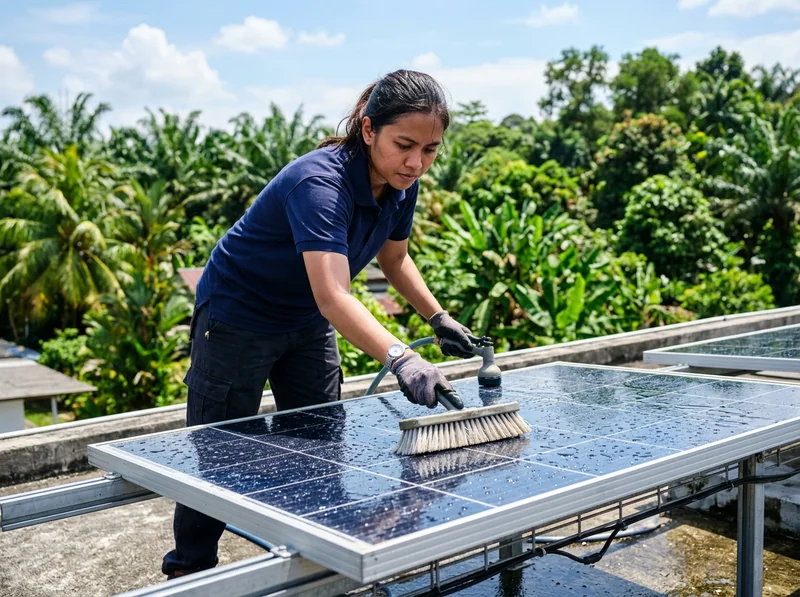
Solar panels in Sabah need minimal maintenance—rain does most of the cleaning. But tropical conditions (humidity, dust, bird droppings, monsoon debris) mean annual professional inspections are recommended. A well-maintained system keeps running at peak efficiency and extends your 25-year warranty. Neglected panels lose 15-25% efficiency over time.
How Tropical Climate Affects Solar Panels
Sabah is one of the most challenging environments for solar systems. Here is what you need to know:
Heat & Temperature
Solar panels are rated at 25°C. For every degree Celsius above that, panel efficiency drops by approximately 0.4%. In Sabah, panels regularly reach 55-65°C in direct sun, meaning your system loses 12-16% efficiency compared to the standard test rating. This is normal and expected—we design systems accounting for this loss.
Humidity & Moisture
High humidity causes potential-induced degradation (PID), where moisture penetrates panel glass and corrodes the electrical connections. Annual inspections detect early PID before it causes failure. High humidity also encourages algae and mold growth on panels, which reduces light transmission.
Monsoon Debris & Dust
The Southwest Monsoon (May-September) brings heavy rain, debris, leaves, and dust accumulation. Bird droppings—a common issue near residential areas—block individual panel cells and create hot spots that can damage the module permanently.
Salt Corrosion (Coastal Areas)
In Kota Kinabalu and coastal Sabah, salt spray from the sea corrodes metal frames, junction boxes, and wiring. Saltwater-exposed systems need more frequent inspections and cleaning.
Thermal Cycling
Daily temperature swings (25°C at night to 65°C during the day) cause metal and glass to expand and contract, creating micro-cracks in panels over time. This is a leading cause of panel degradation in tropical climates.
DIY Maintenance Checklist
You do not need to be an electrician to perform basic checks. Here is what to monitor monthly:
Monthly Tasks:
- Check monitoring app for system output. If generation drops suddenly, note the date and weather conditions.
- Walk around the installation area and look for obvious shading (new trees growing, new structures nearby).
- Visually inspect panels for bird droppings, debris, or cracks. Do NOT attempt to climb onto the roof yourself.
- Ensure the inverter display shows normal operation (no error codes or red lights).
- Check that the inverter fan is clear of dust and can spin freely (do NOT touch the internal components).
Quarterly Tasks:
- Check all visible wiring and connection boxes for water ingress, corrosion, or loose connections.
- Verify no new vegetation is shading the array (common during rainy season growth).
- Inspect the inverter area to ensure it stays dry and well-ventilated (not blocked by storage or furniture).
- Monitor output trends on your app. A 5-10% seasonal variation is normal; larger drops warrant professional review.
What Not to Do:
- Do NOT attempt to clean panels with pressure washers—high pressure damages the anti-reflective coating and waterproof seals.
- Do NOT use harsh chemicals or abrasive materials on panel glass.
- Do NOT work on the system yourself unless you are qualified. Electrical components can cause shock or fire.
- Do NOT ignore error codes on the inverter—they indicate a problem that needs professional attention.
Professional Maintenance: What to Expect
Annual professional maintenance is highly recommended and often included in your system warranty. Here is what a professional service includes:
Cleaning & Visual Inspection
A technician safely cleans panels using soft brushes and deionized water (never harsh chemicals). They inspect for physical damage, cracks, delamination, and discoloration that indicate internal failure.
Thermal Imaging Inspection
A thermographic camera reveals hot spots (damaged cells), broken connections, and failing bypass diodes that are invisible to the naked eye. This is critical for detecting PID and early degradation.
Electrical Testing
Technicians test string voltage and current with a multimeter to ensure proper series connection and identify failed modules. They also check inverter output and ground fault detection.
Connection & Hardware Check
All DC and AC connections are torqued to specification, corrosion is cleaned, and corroded hardware is replaced. Loose connections are a leading cause of fires in solar systems.
Inverter Health Assessment
Inverter efficiency, fan operation, and internal capacitor health are verified. Overheating or failing inverters are caught early before catastrophic failure.
Monitoring System Verification
Your monitoring system is checked to ensure it is reporting accurately and that any performance discrepancies are investigated.
Recommended Maintenance Schedule
| Frequency | Task | DIY or Professional? | Cost / Time |
|---|---|---|---|
| Monthly | Check monitoring app for output, visual panel inspection | DIY | Free / 5 min |
| After heavy monsoon | Check for debris and blockages, inverter status | DIY (call professional if issues found) | Free / 10 min |
| Quarterly | Visual check of wiring, inverter area, shading assessment | DIY | Free / 15 min |
| Annually (CRITICAL) | Full professional cleaning, thermal imaging, electrical testing, connection check | Professional | RM800-1500 / 4-6 hours |
| Every 3-5 years | Detailed PID testing, inverter firmware update, full system performance audit | Professional | RM1500-3000 / full day |
Common Tropical Problems & Solutions
Problem: Hot Spots (Damaged Cells)
Cause: Shading from debris or bird droppings, micro-cracks, or manufacturing defect.
Effect: Damaged cells generate heat instead of electricity, reducing output by 10-30% per affected cell.
Solution: Professional thermal imaging detects hot spots. Affected panels are usually replaced under warranty if the defect is product-related.
Problem: Potential-Induced Degradation (PID)
Cause: High humidity penetrates panel seals over time, especially in systems not properly grounded.
Effect: Slow loss of efficiency (5-20% over 2-3 years). Often invisible until advanced.
Solution: Annual thermal imaging and electrical testing catch PID early. Proper grounding and ventilation prevent it. Some modern panels include built-in PID resistance.
Problem: Inverter Fan Failures
Cause: High humidity causes corrosion of fan bearings. Dust accumulation blocks airflow, causing overheating.
Effect: Inverter shuts down during peak generation, losing power for hours at a time.
Solution: Keep inverter area clean and dry. Quarterly inspection of fan operation. Inverters with sealed fans (IP65 rated) are more reliable in tropical climates—worth the premium cost.
Problem: Bird Nesting in Inverter Area
Cause: Birds build nests in the warm ventilation area under the inverter.
Effect: Blocks airflow, causes overheating and shutdowns. Bird droppings cause corrosion.
Solution: Install a metal mesh guard or bird deterrent around inverter mounting area. Quarterly inspection to remove nests.
Problem: Corroded DC Connectors (Coastal Areas)
Cause: Salt spray corrodes metal connectors and contact surfaces.
Effect: Loose connections create fire hazard and reduce power transmission.
Solution: Use sealed, stainless-steel connectors (not standard brass). Annual cleaning and protection with dielectric grease. Coastal systems should be inspected twice yearly.
Frequently Asked Questions
Can rain clean my panels, or do I need manual cleaning?
Rain cleans panels somewhat, but not completely. Horizontal panels in Sabah accumulate dust, bird droppings, and monsoon debris that rain alone cannot remove. Over time (6-12 months), this accumulation can reduce output by 10-15%. Professional cleaning once per year is recommended. In high-pollution areas or near farms, twice-yearly cleaning may be needed.
My system output dropped 20%. Is something wrong?
Not necessarily. A 5-10% seasonal drop is normal (more clouds, lower sun angle in December-January). A 20% drop suggests shading (new tree growth, building), heavy soiling, inverter malfunction, or a failed panel. Check your monitoring app's weather data first. If the loss persists for more than a week despite clear skies, call a technician for thermal imaging to pinpoint the problem.
What is the cost of annual professional maintenance?
Typical annual professional maintenance (cleaning, thermal imaging, electrical testing) costs RM800-1500 depending on system size and accessibility. Many Easy Solar customers include this in their Essential Suite monthly package (RM120-150/month includes quarterly checks). For large systems, a dedicated maintenance contract is usually cheaper than paying per visit.
How long do solar panels actually last in Sabah?
Quality panels (Tier-1 manufacturers like Jinko, JA Solar, Canadian Solar) are rated for 25+ years and typically degrade at 0.5-0.7% per year. In Sabah, well-maintained systems still operate at 90% capacity after 20 years. Poor maintenance accelerates degradation to 2-3% per year. Annual servicing extends lifespan and maintains warranty coverage, so the investment pays for itself in maintained efficiency.
Is my system covered by warranty for tropical damage?
Yes, most panel manufacturers cover defects (PID, delamination, micro-cracks) for 10 years. Inverter warranties are typically 5-10 years. However, warranty claims require proof of regular maintenance. If your system has never been serviced, manufacturers may deny claims citing negligence. Keep service records and professional inspection reports—they are your warranty insurance.
Schedule Your Annual Maintenance
Keep your system running at peak efficiency with professional tropical maintenance from Easy Solar.
Book a Service on WhatsApp