
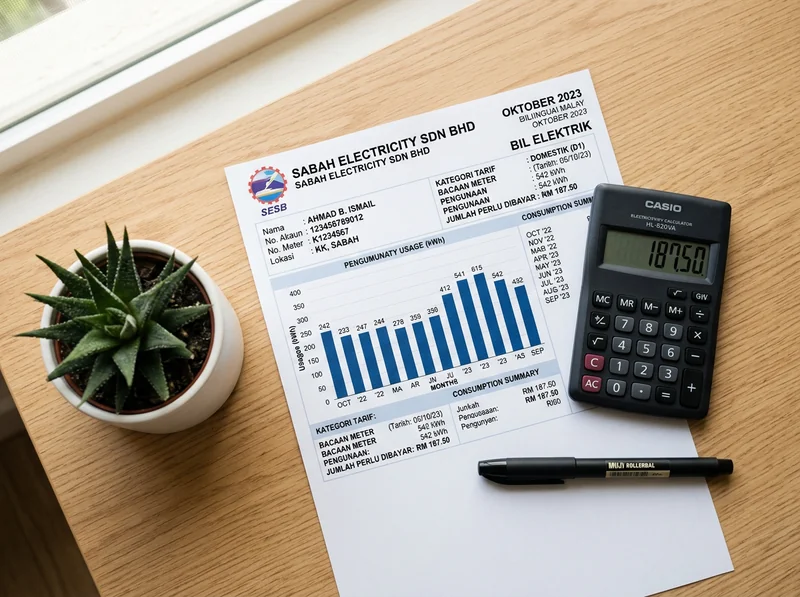
Your SESB bill shows how much electricity you used and what you owe each month. But if you're like most Sabahans, the charges, rates, and blocks can feel confusing. This guide breaks down exactly how SESB calculates your bill, explains the 2026 tariff rates, and shows you how solar panels can permanently reduce what you pay.
What are the main parts of your SESB bill?
Every SESB bill contains three key sections:
- Meter Reading
Your current and previous meter readings (in kilowatt-hours, kWh). SESB calculates your monthly usage by subtracting the old reading from the new one.
- Energy Charges
The cost of electricity based on the block rate system. The more you use, the higher the price per kWh.
- Fixed/Minimum Charge
A base fee of RM5.00 per month to cover network maintenance, meter reading, and administration.
How does SESB calculate your charges?
SESB uses a block rate system. This means the first 100 kWh you use costs one rate, the next 100 kWh costs more, and so on. This encourages efficiency: the more you consume, the more expensive each unit becomes.
What are the 2026 tariff rates?
Effective February 1, 2026, SESB's domestic (DM) tariff rates are:
| Consumption Block | Unit Rate | Example |
|---|---|---|
| 1–100 kWh | 17.5 sen/kWh | 100 kWh = RM17.50 |
| 101–200 kWh | 18.5 sen/kWh | 100 kWh = RM18.50 |
| 201–500 kWh | 33.0 sen/kWh | 300 kWh = RM99.00 |
| 501+ kWh | 34.5 sen/kWh | Above 500 = RM34.50/kWh |
Note: Plus RM5.00 minimum monthly charge. The base tariff is 39.70 sen/kWh, up from 34.52 sen/kWh (effective Feb 2026). The government subsidy of RM849M covers the difference between actual cost (45.08 sen/kWh) and what consumers pay.
Let's see a real example
If you use 400 kWh per month:
- First 100 kWh × 17.5 sen = RM17.50
- Next 100 kWh × 18.5 sen = RM18.50
- Next 200 kWh × 33.0 sen = RM66.00
Subtotal: RM102.00
+ RM5.00 (minimum charge)
Total monthly bill: RM107.00
Why did my bill go up in February 2026?
On February 1, 2026, SESB increased the base tariff from 34.52 sen/kWh to 39.70 sen/kWh. However, the government protected consumers:
- 85% of domestic users (those consuming ≤600 kWh/month) will see bill increases of no more than RM27.
- Small commercial users are protected up to 500 kWh/month, with increases capped at RM24.
- The subsidy mechanism — SESB's actual cost of supply is 45.08 sen/kWh, but the RM849M government subsidy reduces what you pay.
How to calculate if solar makes sense for your bill
The bigger your SESB bill, the faster solar pays for itself. Here's how to decide:
400 kWh/month example
Current monthly SESB bill: RM107
Annual SESB cost: RM1,284
10-year SESB cost: RM12,840
With a 3 kW solar system: Offset 60–70% of your usage (240–280 kWh/month), saving RM700–800/year. Payback: 7–9 years.
Your SESB bill is the single most important document for sizing a solar system. A higher bill means a larger system, faster ROI, and bigger long-term savings.
What's the quickest way to lower your SESB bill?
- Turn off A/C overnight
Air conditioning is 40–60% of most bills.
- Use LED bulbs everywhere
Swap incandescent and fluorescent lights (saves 10–15%).
- Unplug appliances
Standby power (chargers, TVs) adds up (5–10%).
- Install solar
The permanent solution. Offset 50–100% of your usage and eliminate SESB dependence.
Send Us Your SESB Bill on WhatsApp
We'll calculate your solar savings and system size for free — no obligation.
Chat with Us on WhatsAppFrequently Asked Questions
Why is my SESB bill different from my neighbour's?
Usage differs based on appliances, family size, and air conditioning habits. SESB uses block rates, meaning each kWh tier costs more as you use more. A/C units are the biggest consumers.
Is the RM5.00 minimum charge mandatory?
Yes. Even if you use very little, SESB charges a minimum of RM5.00 per month to cover meter reading and network maintenance.
Can I challenge my SESB bill if it seems too high?
Contact SESB customer service with your meter details. They can check for meter faults or unusual consumption. Solar panels can be a permanent solution.
How quickly would solar offset my current SESB costs?
Typically 6–10 years depending on your usage and installation size. Use your bill to size the system — send it to us on WhatsApp for a free estimate.