
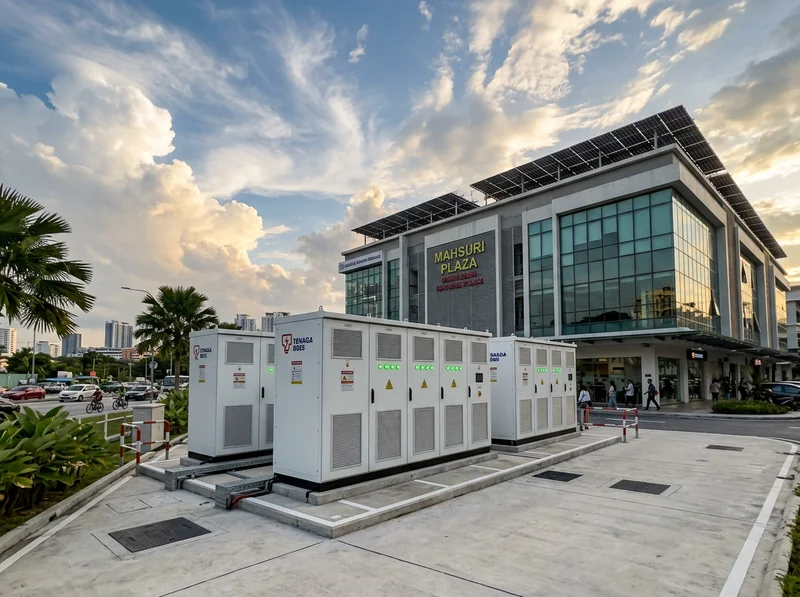
BESS (Battery Energy Storage System) pays off when you have unreliable grid power, high diesel costs, or critical loads that cannot tolerate outages. For businesses with stable grid supply and low electricity bills, grid-tied SELCO solar alone is usually more cost-effective. The decision depends on your energy reliability needs, not just your monthly electricity bill.
What Is BESS?
BESS stands for Battery Energy Storage System. In Sabah, a typical BESS installation pairs your SELCO solar panels with a lithium battery bank (usually LiFePO4 chemistry). Here is how it works:
- Solar panels generate DC electricity during daylight hours
- Inverter/charger converts DC to AC for your building and charges the battery simultaneously
- Battery stores excess solar energy that is not immediately consumed
- At night or during outages, the battery powers your loads without drawing from the grid
- When battery is depleted, the grid supplies power (or your backup diesel generator activates)
Unlike smaller home backup systems, commercial BESS is designed to deliver consistent power for 4–8 hours during peak evening demand or grid outages.
When Does BESS Make Financial Sense?
BESS is worthwhile when ONE or more of these conditions apply to your business:
Criteria for BESS ROI:
- Unreliable grid power
Your area experiences frequent outages (weekly or monthly). Each hour without power costs you more than the system investment.
- High diesel generator dependency
You currently run diesel backup 10+ hours/week. Diesel costs RM3–5 per liter; a BESS prevents those expensive generator cycles.
- Critical operations that cannot stop
Cold storage (fish, vegetables), poultry farming, IT infrastructure, medical equipment, or food processing—downtime costs far exceed electricity savings.
- Remote or island location
Sites like Lahad Datu, Tawau, or island resorts have limited grid capacity. BESS reduces diesel dependency and improves resilience.
- Peak shaving opportunity
Your tariff has time-of-use (ToU) pricing. You pay premium rates 6 PM–10 PM. Battery discharges during peak hours saves 30–50% on peak charges.
When BESS Does NOT Make Sense
Skip BESS if:
- Stable grid supply: You have fewer than 5 outages per year. Your SESB connection is reliable.
- Low electricity bills: You use less than RM3,000/month. The payback period exceeds 12 years.
- Budget constraints: Initial BESS cost is RM200,000+. If capital is tight, invest in SELCO-only first.
- No critical loads: Production can stop temporarily without financial loss. Retail shops, offices, gyms fall here.
- Existing backup solution works: If your diesel generator is reliable and well-maintained, BESS is a secondary concern.
In these cases, a grid-tied SELCO system (without battery) delivers 80% of the financial benefit at half the cost.
| Metric | SELCO Only (No Battery) | SELCO + BESS | Winner |
|---|---|---|---|
| System Size (example) | 50 kWp solar | 50 kWp + 100 kWh battery | — |
| Upfront Cost | RM180,000–220,000 | RM350,000–450,000 | SELCO Only |
| Annual Electricity Savings | RM45,000–60,000 | RM55,000–75,000 | BESS (15–25% higher) |
| Annual Diesel Savings (if used) | None (still need backup) | RM15,000–30,000 (avoids 30–50 diesel runs/year) | BESS |
| Payback Period (electricity only) | 3.5–4.5 years | 6–8 years | SELCO Only |
| Payback Period (with diesel savings) | N/A | 4.5–6 years | BESS (if diesel is relevant) |
| Outage Protection | None (depends on grid) | 4–8 hours per charge cycle | BESS |
| System Lifespan | 25+ years (panels & inverter) | 25 years (solar) + 10–15 years (battery, then replace RM80–120k) | SELCO Only (lower lifecycle cost) |
| Maintenance | Annual monitoring only | Annual battery health checks + software updates | SELCO Only (simpler) |
| Grid Stability Requirement | Stable grid required | Works even with frequent outages | BESS (if unreliable) |
Real-World Easy Solar BESS Portfolio
These three case studies show where BESS delivered measurable ROI in Sabah:
1. Sukau Rainforest Lodge (Kinabatangan, Lahad Datu)
System: 161.25 kWp solar + 307 kWh battery
Challenge: Remote location with 2–3 grid outages per week lasting 4–6 hours each. Lodge guests demand uninterrupted WiFi, AC, and kitchen operation. Diesel generator running cost: RM8,000/month.
Solution: BESS absorbed peak evening demand (6 PM–10 PM), eliminated 40 weekly diesel runs, and reduced outage-related guest complaints to zero.
Outcome: Payback in 4.2 years (electricity + diesel savings combined). Reduced operational noise and maintenance hassles.
2. Poultry Farm (Beaufort)
System: 90 kWp solar + 100 kWh battery
Challenge: Cold storage units, automated feeders, and ventilation fans must run 24/7. A 2-hour outage kills chicks from heat stress. Prior diesel backup: RM15,000/month in fuel.
Solution: Battery provides 4-hour bridge during outages, supplemented by diesel only during extreme weather.
Outcome: Payback in 3.8 years. Diesel use reduced from RM15,000 to RM3,000/month. Zero chick mortality from power failures.
3. Infinity Logistics (Kota Kinabalu)
System: 76.68 kWp solar + 266 kWh battery
Challenge: Warehouse with automated racking and chiller rooms for temperature-sensitive goods. Time-of-use tariff: RM0.55/kWh peak (6 PM–10 PM).
Solution: Battery discharges during peak hours, reducing peak demand charges by 40%. Solar saves daytime consumption. Combined effect: RM65,000+ annual savings.
Outcome: Payback in 5.1 years. System also provided backup during one critical grid failure, preventing RM50,000 in spoiled inventory.
Frequently Asked Questions
How long does a battery last in a BESS system?
Lithium LiFePO4 batteries (industry standard for commercial BESS) last 10–15 years with 4,000–6,000 charge cycles before degradation requires replacement. After 10 years, expect 85–90% capacity retention. Replacement cost is typically RM80,000–120,000 for a 100 kWh system. Easy Solar provides annual battery health reports to monitor capacity.
Can BESS work without solar panels?
Technically yes, but it is not cost-effective. Battery-only systems (charging from the grid at off-peak rates) have long payback periods in Sabah due to the small gap between off-peak (RM0.15/kWh) and peak tariffs (RM0.55/kWh). BESS shines when paired with solar because solar generation is free.
What happens if my battery runs out during an outage?
The system automatically switches to your diesel backup generator (if installed) or the grid resumes power delivery once it is restored. Battery discharge is controlled by software to prevent complete depletion, preserving battery health. You can prioritize critical loads (e.g., cold rooms only) during extended outages.
Is BESS eligible for any government grants or incentives in Sabah?
Currently, BESS does not qualify for net energy metering credits in Sabah (only solar generation does). However, the Energy Commission of Sabah (ECoS) has signaled interest in incentivizing BESS to stabilize the grid. Easy Solar stays updated on any new programmes. Depreciation and tax deductions may apply—consult your accountant.
Unsure If BESS Is Right For Your Business?
Let our ECoS-certified engineers assess your grid reliability, energy patterns, and backup costs to model a BESS ROI specific to your operation.
Chat on WhatsApp